
The INF⁴INiTY project supports knowledge exchange and capacity building through its dedicated Training Programme, complemented by additional webinars and knowledge-sharing activities organised in collaboration with other projects and initiatives.
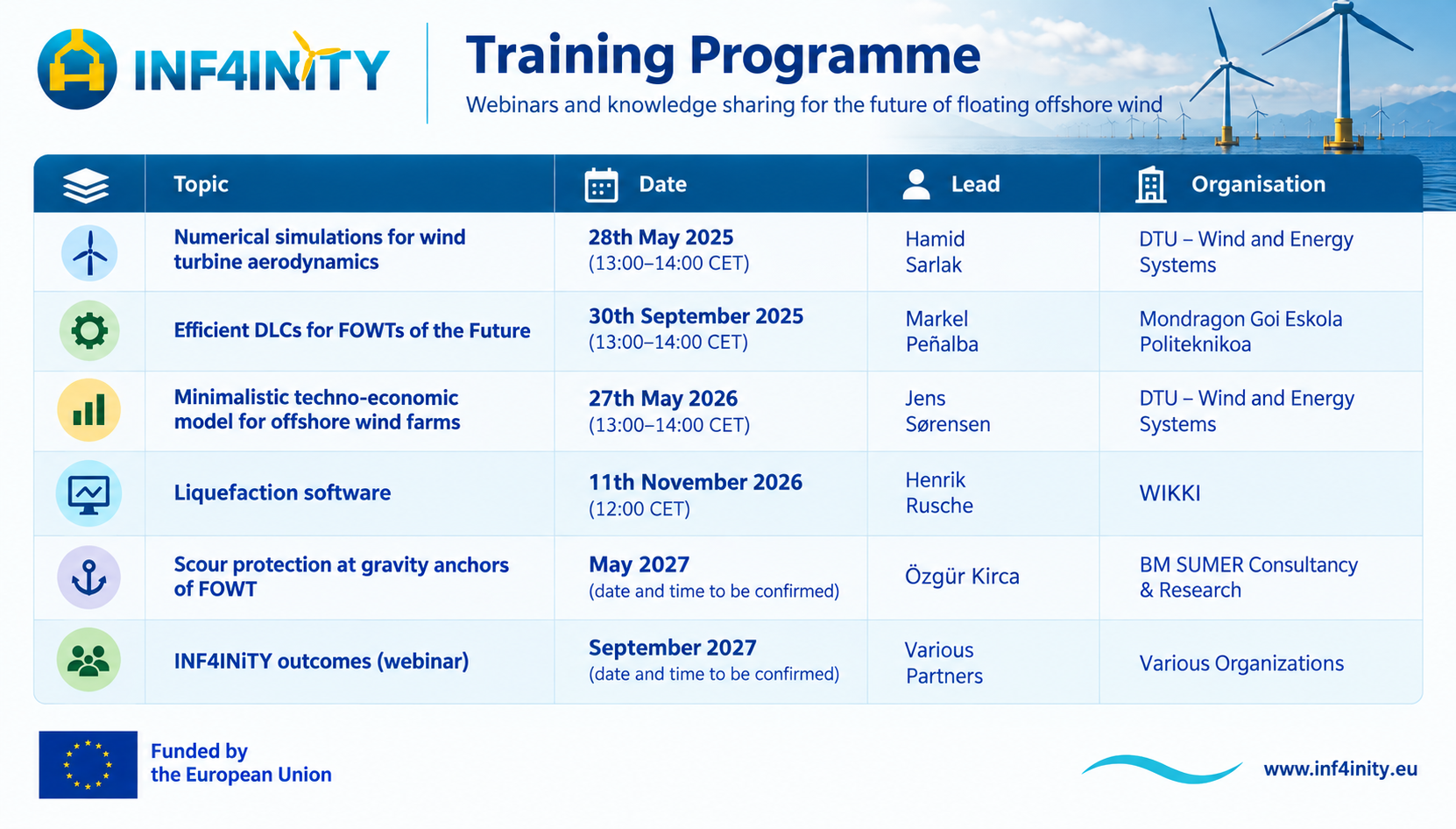
The Training Programme provides researchers, industry professionals and other stakeholders with knowledge and skills relevant to the development of floating offshore wind and nature-inclusive solutions. Through expert-led webinars, it explores key technical and research topics, from wind turbine aerodynamics and design load cases to techno-economic modelling, liquefaction and scour protection.
Alongside the Training Programme, INF⁴INiTY also participates in joint webinars and collaborative sessions with other European projects, creating further opportunities to share knowledge, research data and project results with the wider offshore wind community.
Second INF4INiTY Webinar: Computationally Efficient Site-Specific Design Load Cases for Future Floating Offshore Wind Turbines
The second webinar in the INF4INiTY webinar series was delivered by Markel Peñalba Retes (Mondragon Unibertsitatea) and Gael Verao Fernández (Technische Universität Braunschweig), who presented innovative approaches for developing computationally efficient site-specific design load cases (DLCs) for future floating offshore wind turbines.
The session explored methods for characterising site-specific metocean conditions and demonstrated how clustering techniques can reduce the number of required design load cases while maintaining engineering accuracy. The webinar also addressed the integration of climate change scenarios into turbine design, supporting the development of more resilient and reliable floating offshore wind systems.
Third INF4INiTY Webinar: Minimalistic Techno-Economic Model for Offshore Wind Farms
The third webinar in the INF4INiTY webinar series featured presentations by Jens Nørkær Sørensen (DTU – Technical University of Denmark) and Gael Verao Fernández (Technische Universität Braunschweig), who introduced a minimalistic techno-economic model for offshore wind farms based on the PyWake framework.
During the session, the speakers provided an overview of the modelling approach, including its key inputs, assumptions, and setup. The webinar also presented the model validation process through a North Sea case study, illustrating how simplified techno-economic models can be used to evaluate offshore wind farm energy production and costs while supporting decision-making in the development of future offshore wind projects.
Third INF4INiTY Webinar: Minimalistic Techno-Economic Model for Offshore Wind Farms
The third webinar in the INF4INiTY webinar series featured presentations by Jens Nørkær Sørensen (DTU – Technical University of Denmark) and Gael Verao Fernández (Technische Universität Braunschweig), who introduced a minimalistic techno-economic model for offshore wind farms based on the PyWake framework.
During the session, the speakers provided an overview of the modelling approach, including its key inputs, assumptions, and setup. The webinar also presented the model validation process through a North Sea case study, illustrating how simplified techno-economic models can be used to evaluate offshore wind farm energy production and costs while supporting decision-making in the development of future offshore wind projects.
Joint Webinar: Open Data for Floating Wind – Four EU Projects, One Mission
INF4INiTY joined FLOATFARM, MADE4WIND and TAILWIND for a joint webinar dedicated to open data and its role in advancing floating offshore wind research and innovation.
Bringing together more than 60 participants from research and industry, the session showcased how the four European projects are generating, managing and sharing research data, while highlighting datasets and resources available to the wider offshore wind community.
The webinar explored how open and accessible data can strengthen collaboration, facilitate knowledge exchange and accelerate the development of innovative and sustainable solutions for floating offshore wind.